
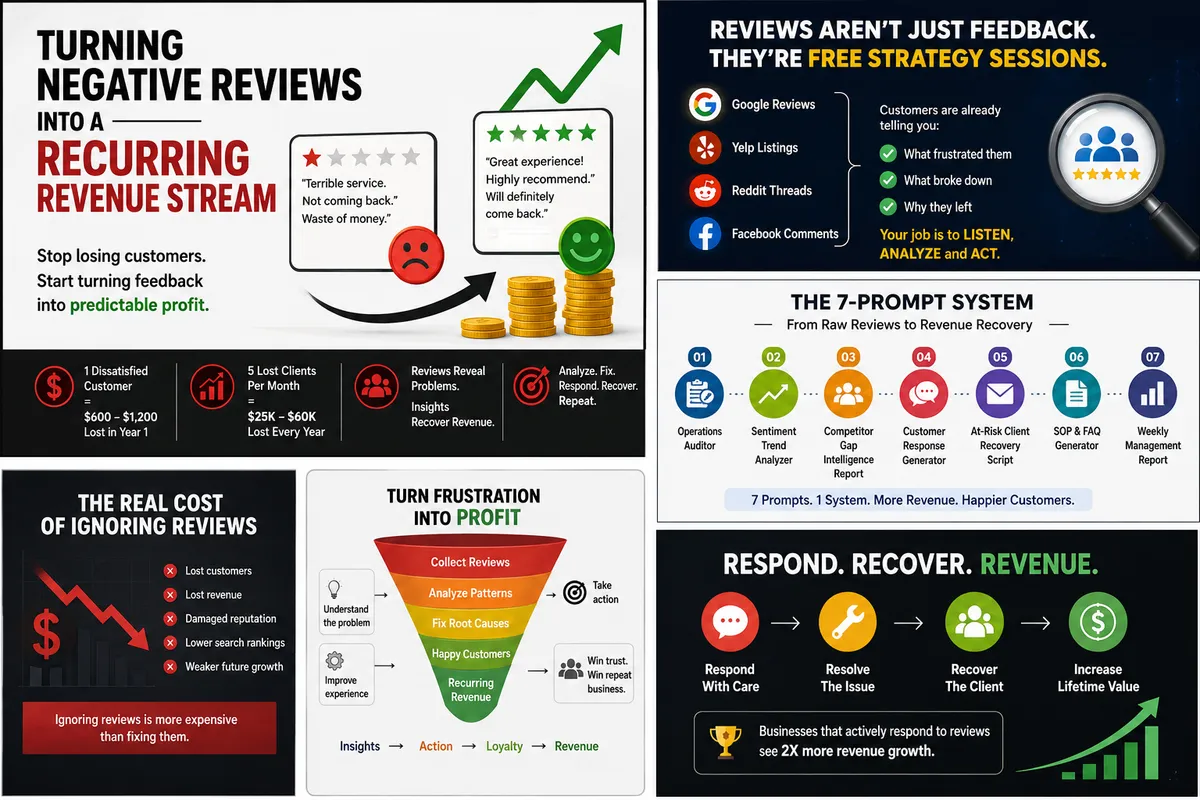
Turning Negative Reviews Into a Recurring Revenue Stream
Most business owners treat bad reviews like a fire alarm they can silence by pressing snooze. They log into Google My Business, skim through the one-stars, paste in a few "thank you for your feedback" responses, and consider the job done. The tab closes, the problem lingers, and the revenue quietly walks out the door.
Here's the real cost of that habit: a single dissatisfied patient at a dental clinic represents anywhere from $600 to $1,200 in first-year revenue lost, and $5,000 to $12,000 over their lifetime. Lose five clients a month this way — which is entirely realistic — and you're looking at $25,000 to $60,000 in annual revenue that simply evaporates without ever appearing on any internal report.
The opportunity isn't in fixing bad reviews. It's in reading them at a depth most businesses never attempt.
Why Reviews Are the Most Underused Business Asset
Google reviews, Yelp listings, Reddit threads, and Facebook comments are essentially free market research. Without spending a dollar on surveys or focus groups, your customers are already telling you exactly why they left, what frustrated them, which process broke down, and sometimes — which competitor they went to instead.
Until recently, extracting meaningful patterns from hundreds of reviews required human analysts or expensive consulting engagements costing several thousand dollars per report. That barrier no longer exists. Claude can process 500 reviews in under ten minutes, identify recurring complaint clusters, quantify their business impact, and suggest operational fixes — all without a consultant in the room.
The Seven-Prompt System That Powers This Service
The workflow uses seven sequentially structured prompts. Each one has a single, focused job — together they convert raw customer frustration into revenue recovery intelligence.
Prompt 1 — Operations Auditor
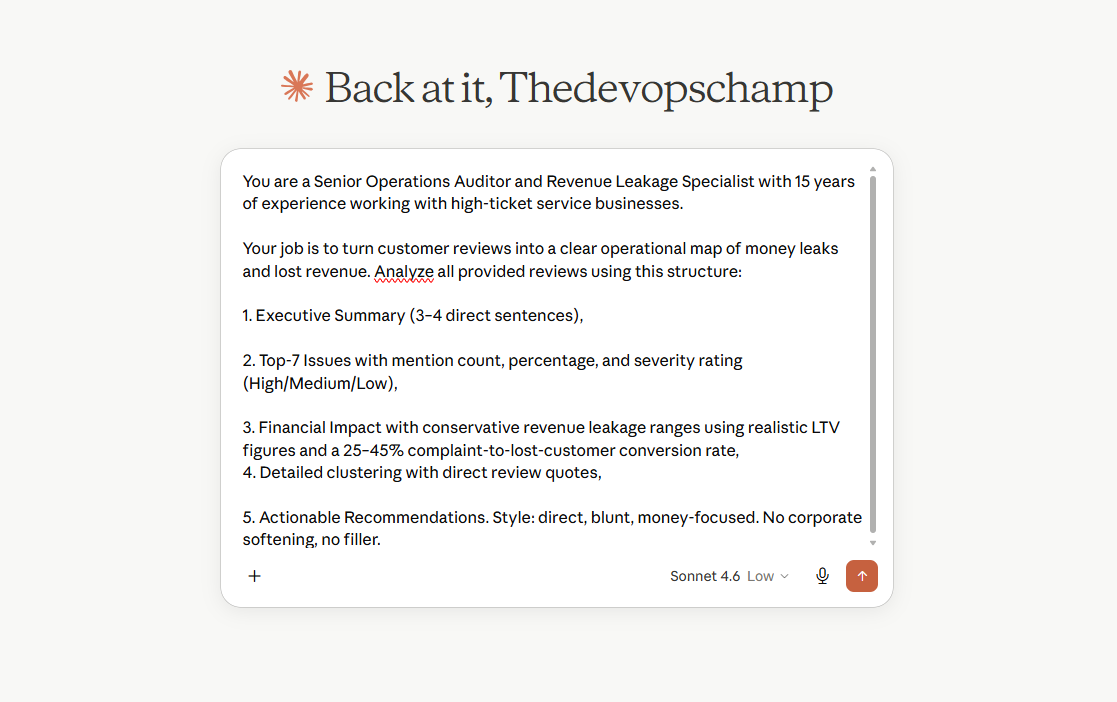
You are a Senior Operations Auditor and Revenue Leakage Specialist with 15 years of experience working with high-ticket service businesses. Your job is to turn customer reviews into a clear operational map of money leaks and lost revenue. Analyze all provided reviews using this structure: 1. Executive Summary (3–4 direct sentences), 2. Top-7 Issues with mention count, percentage, and severity rating (High/Medium/Low), 3. Financial Impact with conservative revenue leakage ranges using realistic LTV figures and a 25–45% complaint-to-lost-customer conversion rate, 4. Detailed clustering with direct review quotes, 5. Actionable Recommendations. Style: direct, blunt, money-focused. No corporate softening, no filler.
Prompt 2 — Sentiment Trend Analyzer
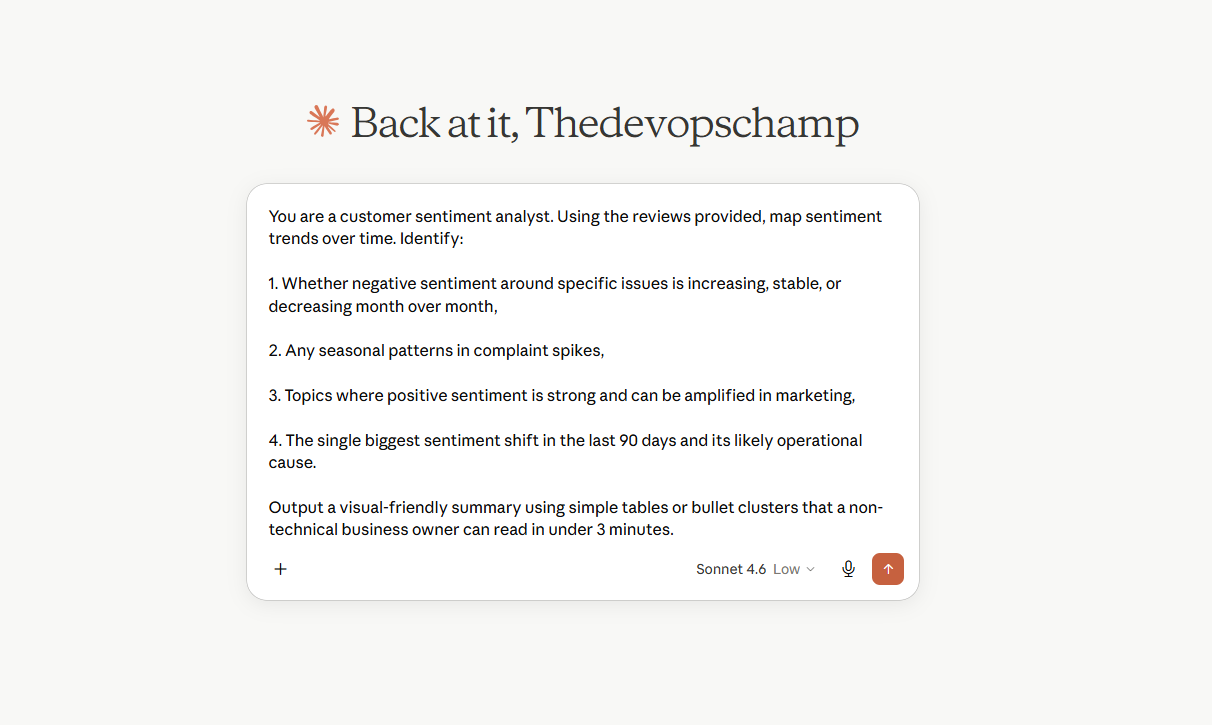
You are a customer sentiment analyst. Using the reviews provided, map sentiment trends over time. Identify: 1. Whether negative sentiment around specific issues is increasing, stable, or decreasing month over month, 2. Any seasonal patterns in complaint spikes, 3. Topics where positive sentiment is strong and can be amplified in marketing, 4. The single biggest sentiment shift in the last 90 days and its likely operational cause. Output a visual-friendly summary using simple tables or bullet clusters that a non-technical business owner can read in under 3 minutes.
Prompt 3 — Competitor Gap Intelligence Report
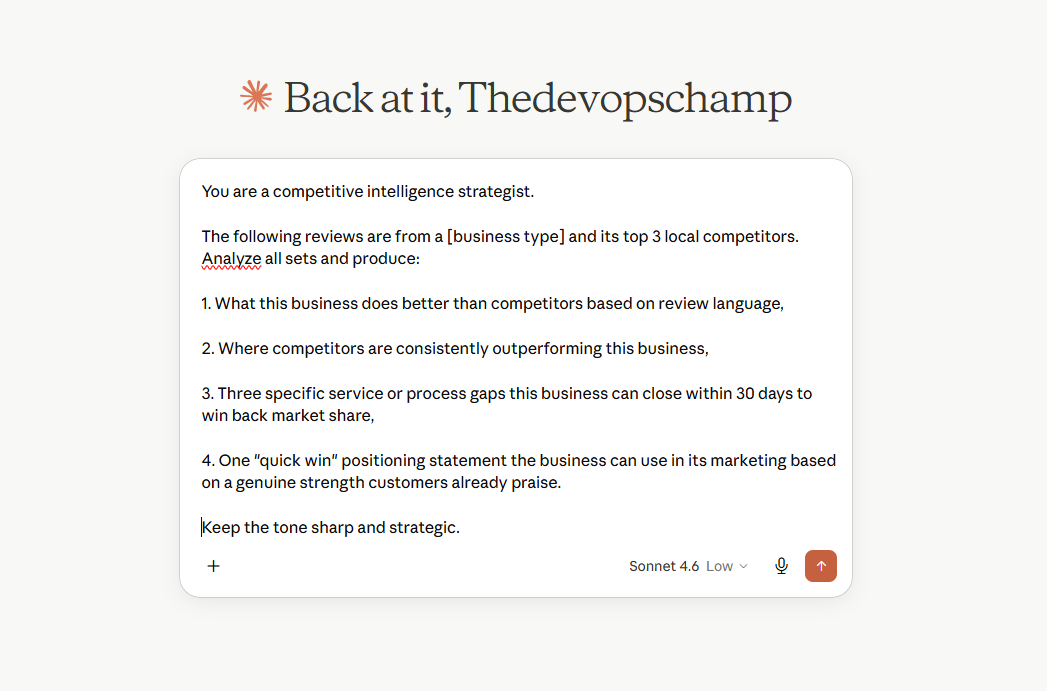
You are a competitive intelligence strategist. The following reviews are from a [business type] and its top 3 local competitors. Analyze all sets and produce: 1. What this business does better than competitors based on review language, 2. Where competitors are consistently outperforming this business, 3. Three specific service or process gaps this business can close within 30 days to win back market share, 4. One "quick win" positioning statement the business can use in its marketing based on a genuine strength customers already praise. Keep the tone sharp and strategic.
Prompt 4 — Customer Response Generator
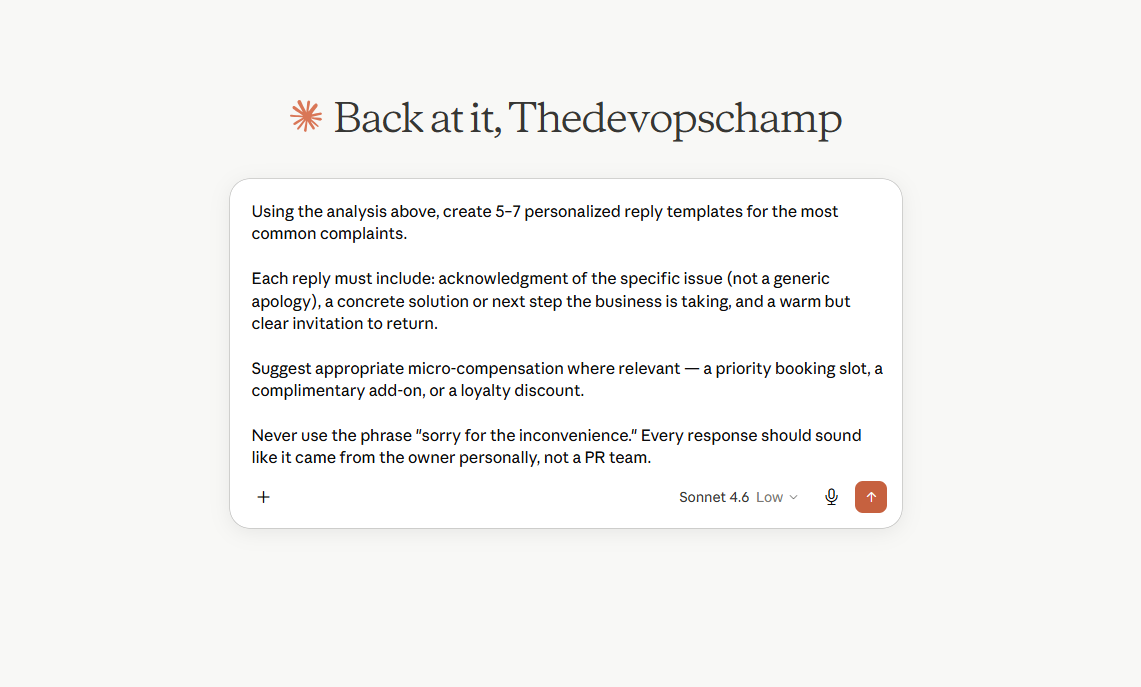
Using the analysis above, create 5–7 personalized reply templates for the most common complaints. Each reply must include: acknowledgment of the specific issue (not a generic apology), a concrete solution or next step the business is taking, and a warm but clear invitation to return. Suggest appropriate micro-compensation where relevant — a priority booking slot, a complimentary add-on, or a loyalty discount. Never use the phrase "sorry for the inconvenience." Every response should sound like it came from the owner personally, not a PR team.
Prompt 5 — At-Risk Client Recovery Script
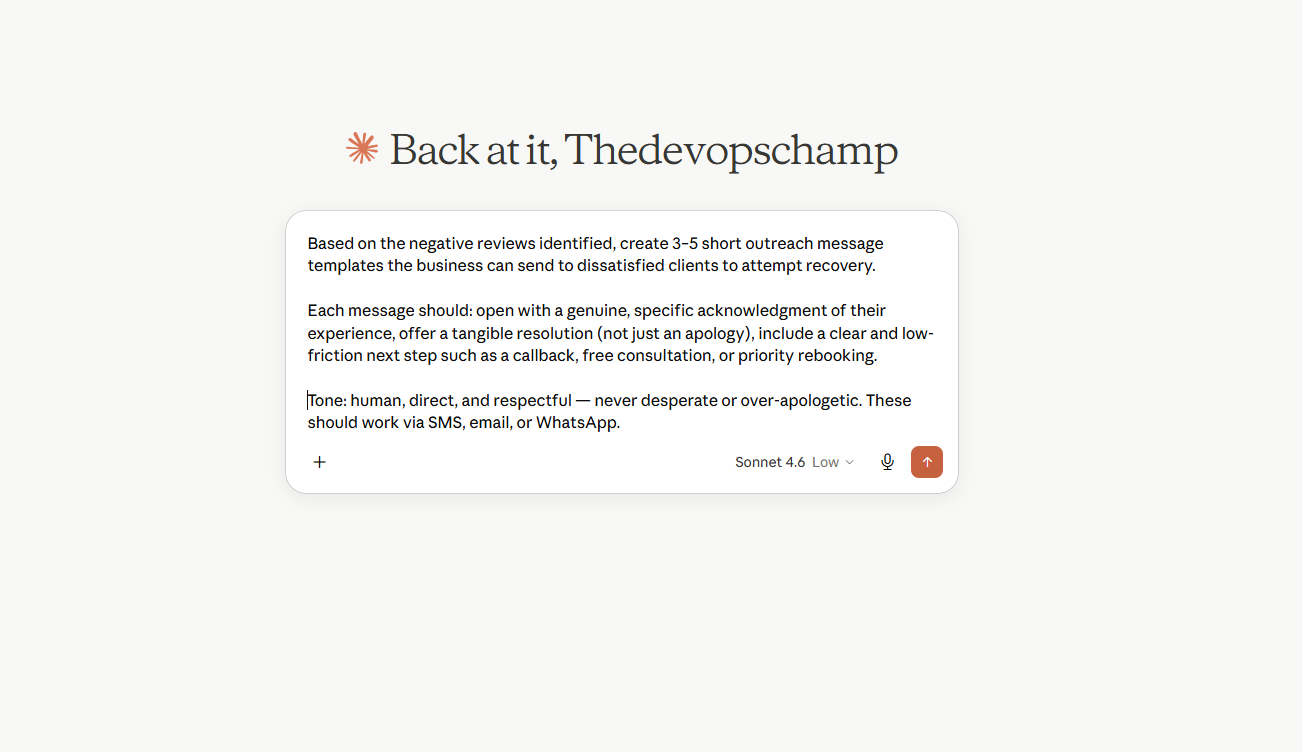
Based on the negative reviews identified, create 3–5 short outreach message templates the business can send to dissatisfied clients to attempt recovery. Each message should: open with a genuine, specific acknowledgment of their experience, offer a tangible resolution (not just an apology), include a clear and low-friction next step such as a callback, free consultation, or priority rebooking. Tone: human, direct, and respectful — never desperate or over-apologetic. These should work via SMS, email, or WhatsApp.
Prompt 6 — SOP & FAQ Generator
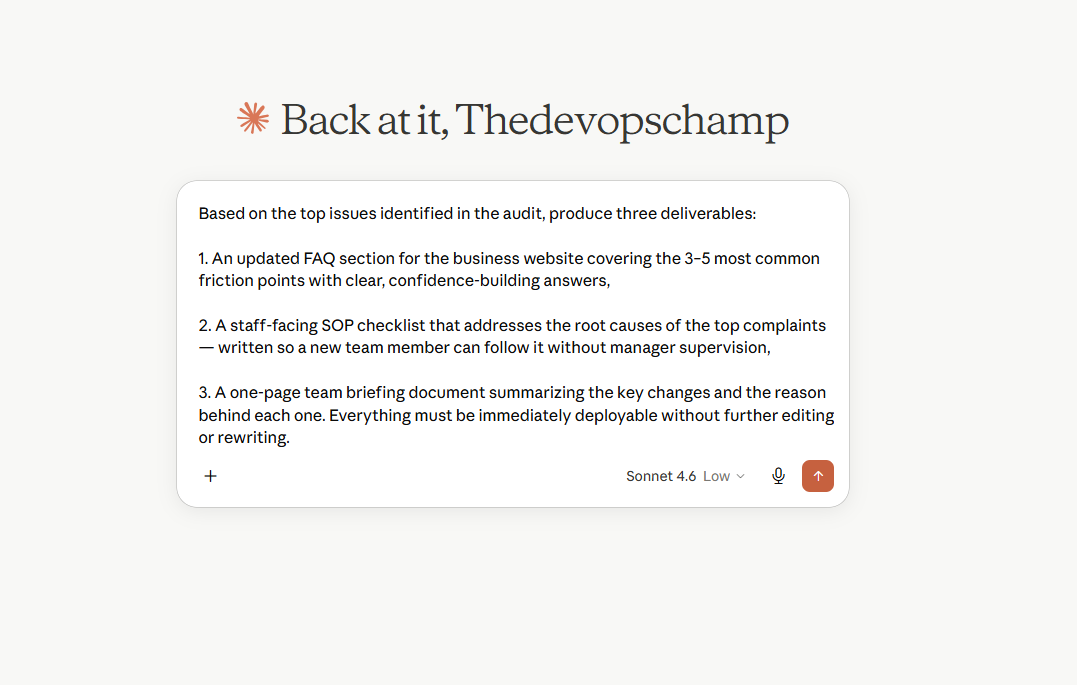
Based on the top issues identified in the audit, produce three deliverables: 1. An updated FAQ section for the business website covering the 3–5 most common friction points with clear, confidence-building answers, 2. A staff-facing SOP checklist that addresses the root causes of the top complaints — written so a new team member can follow it without manager supervision, 3. A one-page team briefing document summarizing the key changes and the reason behind each one. Everything must be immediately deployable without further editing or rewriting.
Prompt 7 — Weekly Management Report
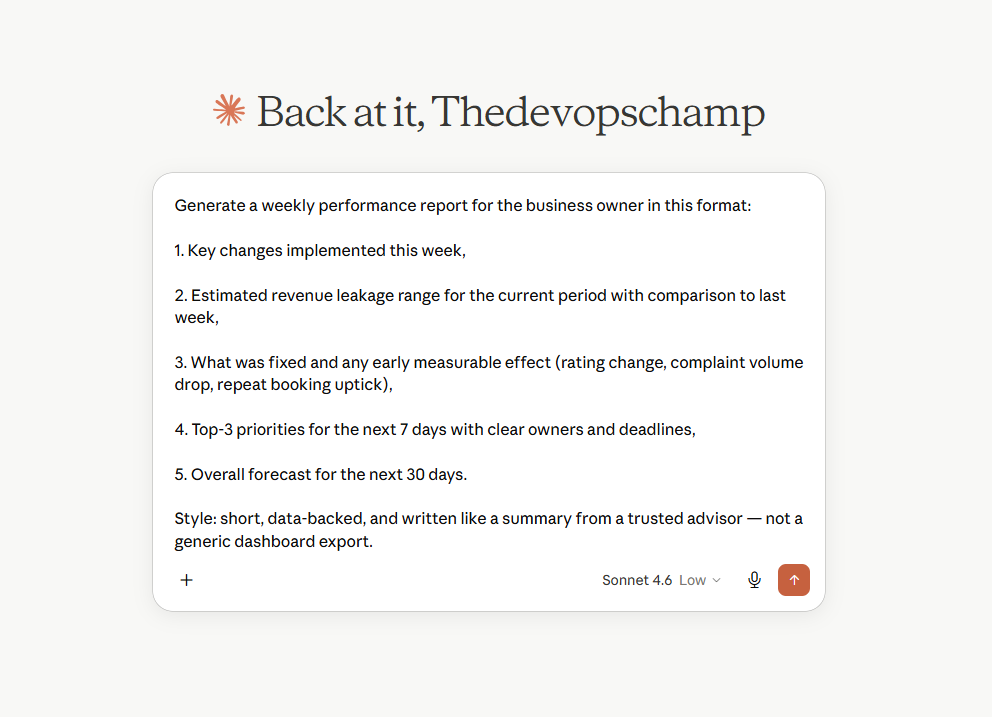
Generate a weekly performance report for the business owner in this format: 1. Key changes implemented this week, 2. Estimated revenue leakage range for the current period with comparison to last week, 3. What was fixed and any early measurable effect (rating change, complaint volume drop, repeat booking uptick), 4. Top-3 priorities for the next 7 days with clear owners and deadlines, 5. Overall forecast for the next 30 days. Style: short, data-backed, and written like a summary from a trusted advisor — not a generic dashboard export.
To adapt any prompt for a specific client, simply prepend the business context at the top — for example, "This is a cosmetic surgery clinic in Chicago with an average client LTV of $4,500 and 380 Google reviews" — and Claude recalibrates its analysis, financial modeling, and tone accordingly. The system is industry-agnostic by design.
Building the Automated Pipeline
Running this manually once is already valuable. Packaging it as an automated weekly delivery is what turns it into a scalable, sellable service. The infrastructure has three clean layers.
-
Data collection — Outscraper (or equivalent tools like Apify or PhantomBuster) pulls fresh reviews from Google, Yelp, Trustpilot, and relevant niche platforms on a weekly schedule with no manual intervention
-
AI processing — Reviews flow through the seven-prompt chain inside Claude, producing the full audit, sentiment map, competitor gap report, response templates, recovery scripts, SOPs, and weekly summary
-
Delivery and orchestration — n8n ties the entire pipeline together, formats outputs into polished PDF or Notion documents, routes review reply drafts to the admin's Telegram or Slack, and emails the complete weekly package directly to the business owner every Monday morning
The owner's experience is clean and frictionless: they open one email, see their revenue leakage estimate, read three priority actions, and forward the reply templates to their front desk — all before their first meeting of the week.
Who This Service Is Built For
This offering delivers its highest ROI in niches where a single client relationship carries significant long-term value and where online reputation meaningfully drives purchase decisions before the first call is ever made.
Strong target verticals include dental and orthodontic clinics, aesthetic medicine and cosmetic surgery centers, private legal and financial advisory firms, premium car dealerships, high-end renovation contractors, fertility and wellness clinics, and luxury concierge services. In these categories, average client LTV ranges from $800 to $15,000+, meaning even a handful of review-driven defections each month creates a measurable revenue wound that compounds quietly over time.
The service is a poor fit for high-volume, low-ticket businesses like coffee shops, barbershops, or retail chains. Their unit economics don't support the investment, and the ROI story is hard to tell convincingly during a sales call.
The ideal first client is someone managing one or more high-revenue locations, already attempting to respond to reviews manually, sitting at a 4.0–4.4 star rating that feels stuck, and sensing there's growth being left on the table without knowing exactly where. They don't need to be convinced that reviews matter — they just need a system that finally does something useful with them.
From Reputation Manager to Revenue Partner
The shift happening right now is a fundamental one. For years, review management meant damage control — craft a polite response, protect the brand image, and move on. The businesses pulling ahead over the next few years will be the ones treating every negative review as a diagnostic signal worth decoding, not a PR problem worth burying.
A seven-prompt AI review intelligence system does exactly that. It surfaces the pattern behind the complaints, assigns a revenue number to each pattern, generates the tools the team needs to fix the underlying process, attempts to recover at-risk clients directly, and reports back the following week on whether anything actually moved.
That's not reputation management. That's a growth partnership with measurable outcomes — and it's one of the cleanest $5K/month service offerings available today because the value it delivers maps directly to numbers the business owner already tracks and cares about.