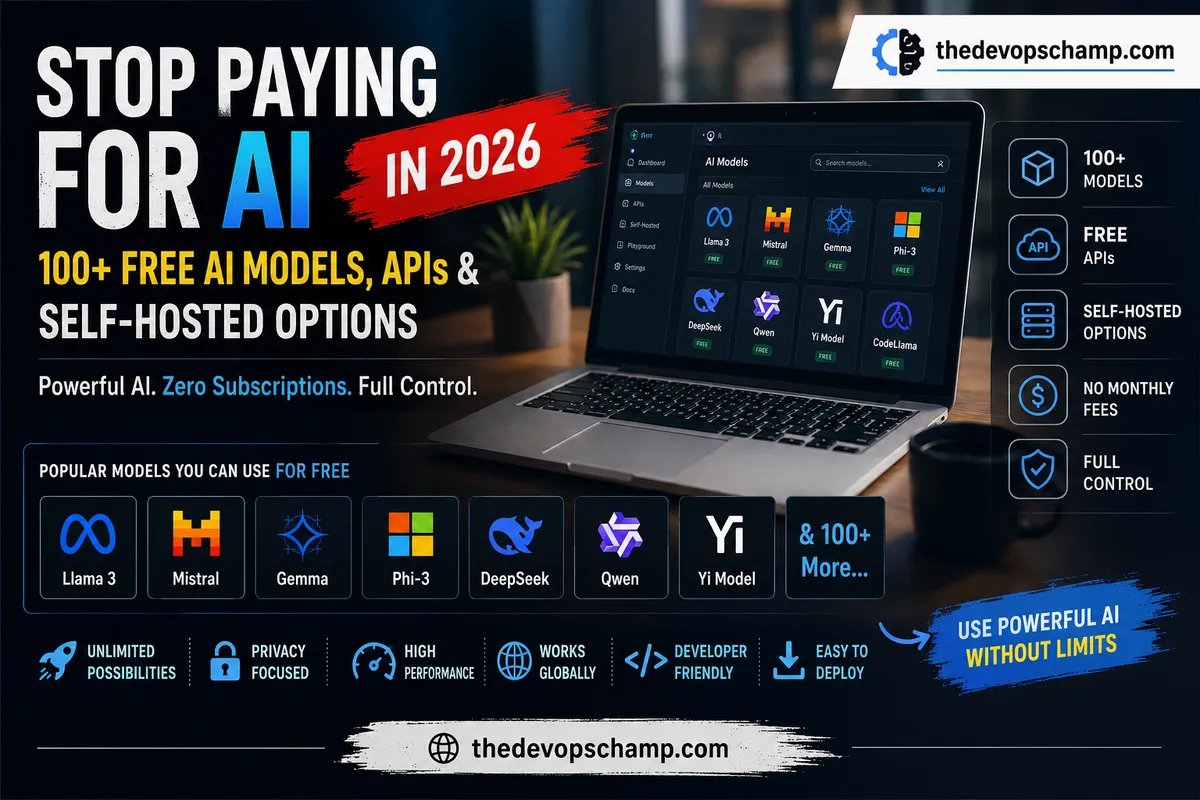
Stop Paying for AI: 100+ Premium Models You Can Access for Free Right Now
Between ChatGPT Pro, Claude, Gemini Advanced, and Cursor — a developer running all four subscriptions burns through $80 every single month. That's nearly $1,000 a year. And the uncomfortable truth is, most of those capabilities are available right now at absolutely zero cost, through legitimate channels that have been quietly expanding for the past year.
I spent several days mapping every free tier, free credit program, self-hosted option, and open-weight model that genuinely works in 2026. No credit card traps. No "free for 7 days then surprise billing at midnight." What follows is that complete map — organized so you can go from reading to running in under five minutes.
The Two Types of Free AI (And Why the Difference Matters)
Before diving into the list, understand that "free AI" refers to two fundamentally different things.
The first type is hosted free APIs — where a company like Google, Groq, or Mistral runs the model on their servers and hands you an API key at no cost. You get real frontier models with real rate limits. The tradeoff: your prompts may pass through their systems, and some providers use free-tier data for model training.
The second type is self-hosted models — where you download model weights and run everything locally. Fully private, no rate limits, no subscription. You pay in compute (electricity and VRAM) rather than cash or data.
These are not variations of the same thing. They are opposing ends of a spectrum. Choose based on your priority: convenience or privacy.
Permanently Free Hosted APIs
These are not trials. Not promotions with expiry dates. Real API access — free forever within stated rate limits.
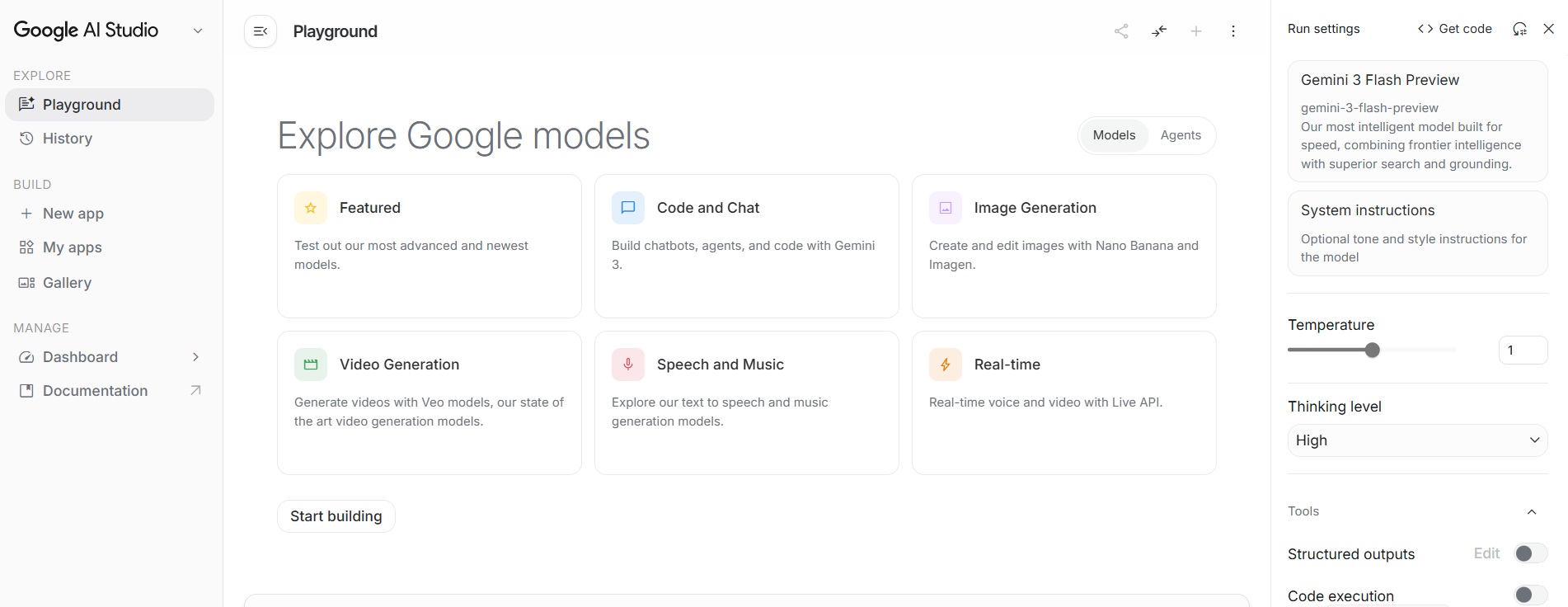
Google AI Studio
If you want one free AI tool and nothing else, this is it. Google's AI Studio gives you direct API access to Gemini Flash with roughly 1,500 requests per day, a one-million-token context window, and native support for images and PDFs. No credit card. No expiry. Just sign in at aistudio.google.com with your Google account, copy your API key, and you're live.
The catch worth knowing: Google's free tier may use your prompts for model improvement. Keep sensitive client data, credentials, and proprietary business logic off this endpoint.
Groq
For raw inference speed, nothing on the free market currently matches Groq. Built on custom LPU (Language Processing Unit) hardware, Groq delivers 300+ tokens per second on open-weight models including Llama, Qwen, and Kimi. The free tier allows around 30 requests per minute and 1,000 requests per day on 70B-class models — plenty for active development use.
Groq has an explicit no-training policy, meaning your prompts stay your prompts. The API is fully OpenAI-compatible, so you change a single base URL and your existing tools work immediately.
Sign up at console.groq.com — no card required.
Mistral La Plateforme
Mistral hands you one billion free tokens on signup. That is not a typo. Their catalog includes Mistral Large 3, Codestral (which outperforms several frontier coding models on benchmarks), Pixtral Large for vision tasks, and Mistral Medium — all with 256K context windows and OpenAI-compatible endpoints.
One important setting: head to Settings → Data Training and disable the training opt-in if you care about prompt privacy. The free "Experiment" tier defaults to training-on. It's a checkbox — flip it.
curl https://api.mistral.ai/v1/chat/completions \
  -H "Authorization: Bearer YOUR_KEY" \
  -H "Content-Type: application/json" \
  -d '{"model": "mistral-small-latest", "messages": [{"role": "user", "content": "Hello"}]}'
OpenRouter
One API key. One endpoint. 25+ permanently free models, filtered with the :free suffix. The rotation includes Llama 3.3 70B, DeepSeek V3, Qwen3, and Mistral 7B, among others. OpenRouter is particularly useful when you want model flexibility without managing multiple provider accounts.
Visit openrouter.ai — no credit card, no expiry.
Cerebras
Cerebras runs wafer-scale chip inference and, in some workloads, outpaces even Groq. Their free tier covers Qwen3 235B and carries an explicit no-training policy. The API is OpenAI-compatible. If speed matters for your pipeline, this deserves a slot in your stack.
Register at cloud.cerebras.ai.
GitHub Models
If you have a GitHub account, you already have free access to GPT-4o, GPT-4.1, Llama 4, Mistral, and DeepSeek. Rate-limited, but genuinely free within development use. This is ideal for building and testing without any additional account setup.
Access it at github.com/marketplace/models.
Cloudflare Workers AI
Cloudflare's free tier gives you 10,000 "neurons" per day on their edge inference network. Models include Kimi K2, GLM-4.7 Flash, and IBM Granite 4. This is particularly valuable if you're building serverless applications that need inference running close to end users — latency drops significantly on edge deployments.
Documentation at developers.cloudflare.com/workers-ai.
Hugging Face Inference API
Thousands of models. Serverless. No credit card. Cold starts are real and rate limits are tight, but for exploring niche or newly released models, nothing beats Hugging Face's breadth.
One-Time Free Credits Most Developers Miss
These are not permanent free tiers — but they're large enough to carry you through months of serious development.
AWS Bedrock — $200 Free Credits
Every new AWS account receives $200 in promotional credits. You can apply those directly toward Anthropic's full Claude lineup on Bedrock: Opus 4, Sonnet 4.6, and Haiku 4.5. A credit card is required for account verification, but you will not be charged unless you exceed the credit balance.
To activate: create a free AWS account → search "Bedrock" → request model access for Anthropic → open the Chat Playground → start using Claude immediately.
Strategy: use Claude Haiku for high-volume, simpler tasks (it's 10–20x cheaper per token than Opus), and reserve Opus for hard reasoning work. $200 goes a long way when you route intelligently.
AgentRouter — $100 Free Credits
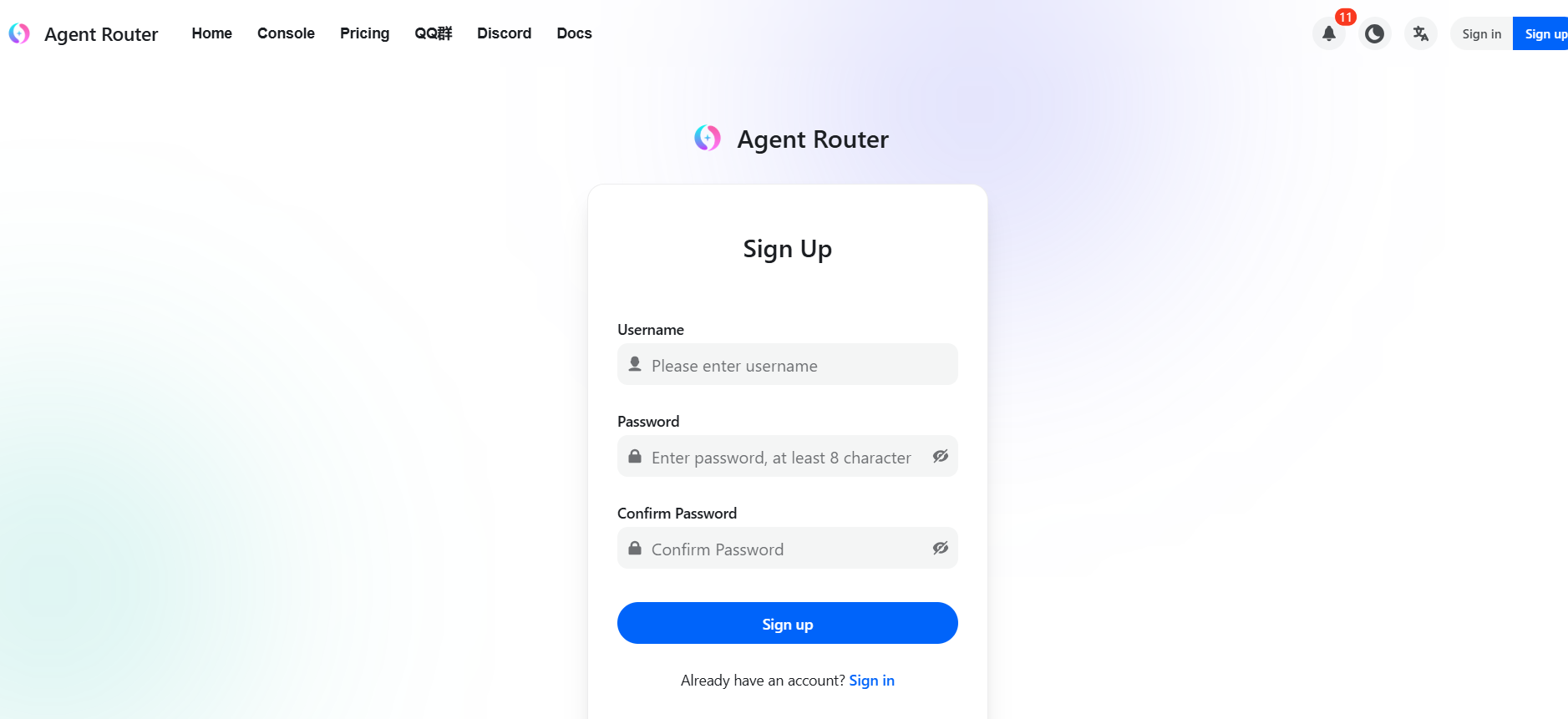
AgentRouter is a non-profit AI gateway that drops $100 in credits into your account on GitHub login. Their catalog spans Claude Sonnet, GPT-4o, DeepSeek R1 and V3, GLM-4.5, Qwen3, and Gemini 2.0 Pro — all under one base URL.
One caveat: AgentRouter runs on Singapore infrastructure but is China-based operationally. Suitable for learning, side projects, and prototypes. Not recommended for client data or anything sensitive.
Register at agentrouter.org/register.
Runtime by Bad Theory Labs — 10M Tokens/Month
Ten million tokens per month with just a Google login. The catalog at runtime.badtheorylabs.com includes Claude Opus 4, GPT-5.5, DeepSeek V4, GLM 5.2, Kimi K2.6, Gemini, and 340+ additional models. Their API key (prefixed BTL_) drops into any OpenAI-compatible tool — Cursor, Aider, Claude Code, LangChain — without configuration changes.
Note: this is a launch promotion. Free allocation will likely decrease as they scale. Claim it now.
OpenAI Data Sharing Program — 250K Tokens/Day
This program is buried deep in OpenAI's platform settings and the vast majority of developers have never seen it. Opt in to both data-sharing options under Platform → Settings → Data Controls → Sharing, and you unlock 250,000 free tokens per day on GPT-5.5 and GPT-5.2, plus 2.5 million tokens per day on their Mini and Nano variants. Resets daily.
Requirements: a positive account balance and willingness to have your prompts used for OpenAI training. Ideal for personal builds and learning. Keep client work elsewhere.
Chinese Frontier Models — All Currently Free
Five models that compete directly with GPT and Claude, all accessible through a single NVIDIA API key.
# Sign up at build.nvidia.com (phone verify, no card)
# Base URL: https://integrate.api.nvidia.com/v1

curl https://integrate.api.nvidia.com/v1/chat/completions \
  -H "Authorization: Bearer nvapi-YOUR_KEY" \
  -H "Content-Type: application/json" \
  -d '{"model": "deepseek/deepseek-v4-flash", "messages": [{"role":"user","content":"Hello"}]}'
Available models on NVIDIA's catalog:
-
DeepSeek V4 Flash — fastest inference in the catalog, extremely cost-efficient
-
MiniMax M3 — 1M context window, strong on SWE-Bench coding benchmarks
-
Qwen3.5-397B — complex reasoning at a scale that competes with frontier closed models
-
Kimi K2.6 — purpose-built for agentic workflows, 1 trillion parameters
-
GLM 5.1 — reliable all-rounder for daily AI tasks
The NVIDIA catalog covers 100+ models total, all under a ~40 request/minute rate limit. One key, one base URL, works in Claude Code, Cursor, Cline, and Aider.
GLM 5.2 — The Free Model Beating GPT on Coding
GLM 5.2 (Zhipu AI) recently scored 62% on SWE-Bench Verified. GPT-5.5 scored 58.6%. It's open-weight, MIT licensed, and you can access it free two ways:
ZCode IDE gives you 3 million free tokens per day with GLM 5.2 as the default model. Download at zcode.z.ai, sign up with email (no card, no phone), and you're running a model that outperforms GPT-5.5 on coding benchmarks from day one.
Zenmux offers a free trial window via API. Sign up with Gmail at zenmux.ai, generate a key, and point your tools at https://zenmux.ai/api/v1.
Self-Hosting: Full Privacy, Zero Cost
No API key. No rate limits. No data leaving your machine. You pay in electricity and VRAM.
Getting Started with Ollama
# Install on Mac, Linux, or Windows
curl -fsSL https://ollama.com/install.sh | sh

# Run models (auto-downloads weights)
ollama run qwen3:8b          # 5.5GB — versatile everyday model
ollama run llama3.3:70b      # 40GB — near-frontier quality
ollama run mistral:7b        # 5GB — fast and capable
ollama run deepseek-r1:14b   # 9GB — strong at reasoning
ollama run phi4:14b          # 9GB — punchy on limited hardware

# Serves OpenAI-compatible API at localhost:11434/v1
RAM rule of thumb: ~0.6 GB per billion parameters at 4-bit quantization. An 8B model needs roughly 5–6 GB. A 70B model needs 40+ GB.
Best Open-Weight Models to Self-Host
Commercial use, clean licenses:
-
Qwen3 (Apache 2.0) — Alibaba's lineup from 0.6B to 200B+, genuinely excellent across tasks
-
DeepSeek-R1 (MIT) — strong reasoning, distillations from 7B to 70B
-
Phi-4 (MIT) — Microsoft's small but powerful family, Phi-4-mini runs on any modern laptop
-
Mistral / Devstral (Apache 2.0) — Devstral specifically tuned for coding agents
-
GLM (MIT) — leads coding benchmarks at larger sizes
-
Granite (Apache 2.0) — IBM's enterprise and RAG-focused lineup
Open-weight with conditions:
-
Llama 3.x (Meta) — not truly open-source but broadly usable; 8B to 70B sweet spot
-
Gemma 4 (Google) — restricts using weights to train competing models; 12B fits in 16GB
-
Falcon-H1 — 256K context, royalty above $1M revenue
FreeLLMAPI: Stack All Providers Under One Endpoint
FreeLLMAPI is an open-source self-hosted proxy that aggregates free tiers from 16 providers — Google, Groq, Cerebras, Mistral, OpenRouter, GitHub, Cloudflare, Hugging Face, and more. It auto-routes requests to whichever provider isn't rate-limited, handles 429 fallbacks automatically, and tracks per-key usage against every provider's cap.
Combined, the aggregated free capacity amounts to roughly 1.7 billion tokens per month.
# One-command Docker install
curl -fsSL https://freellmapi.co/install.sh | bash
# Runs at http://localhost:3001
# Add your provider keys, start routing

# For Claude Code specifically:
export ANTHROPIC_BASE_URL=http://localhost:3001
export ANTHROPIC_AUTH_TOKEN=freellmapi-your-unified-key
claude
The proxy is OpenAI-compatible and Anthropic-compatible. Your existing tools plug in without modification.
Source and setup: github.com/tashfeenahmed/freellmapi
The Master Directory
The awesome-free-models repository by 12britz consolidates 300+ verified links across:
-
50+ free API providers with no credit card requirement
-
30+ open-weight models for self-hosting
-
Local inference tools (Ollama, llama.cpp, vLLM)
-
Coding assistants, CLI tools, RAG frameworks
-
Agentic frameworks and fine-tuning playgrounds
It's actively maintained, categorized clearly, and saves hours of research time.
The Privacy Tradeoff You Must Understand
Free hosted tiers come with a real cost that isn't measured in dollars.
No-training policy confirmed:
-
Groq — explicit policy, your prompts are not used for training
-
Cerebras — same explicit protection
-
GitHub Models — scoped to development use
-
Self-hosted — 100% private by definition
Use caution with sensitive data:
-
Google AI Studio free tier — may use prompts for training
-
Mistral Experiment tier — training opt-in is the default
-
Hugging Face Inference — standard commercial terms apply
The rule is simple: if the prompt contains client data, production credentials, proprietary business logic, or anything you wouldn't want surfacing in someone else's training set — self-host it or pay for a privacy tier.
Your 5-Minute Starting Point
Match your situation to the right path:
-
"I want frontier AI with zero setup" → Google AI Studio. Sign in. Done.
-
"I need fast inference for an agent pipeline" → Groq. API key in 2 minutes.
-
"I want Claude without paying" → AWS Bedrock. $200 credits. Follow the steps above.
-
"I want 100+ models on one key" → NVIDIA API. Phone verify, no card.
-
"Privacy is non-negotiable" →
→curl -fsSL https://ollama.com/install.sh | shollama run qwen3:8b→ Done. -
"I want everything automated and stacked" → FreeLLMAPI. One Docker command. 1.7B tokens/month.
The gap between what developers pay for AI access and what AI access actually costs has never been wider. A year ago, paying $80/month made sense because options were scarce. In mid-2026, it no longer does. Every resource listed here is live, tested, and accessible today. Claim the credits, set up the router, run the local model — and redirect that $80 toward something that actually requires it.